Premature wear can turn otherwise usable tooling, shafts, rolls, bearings, and production components into expensive sources of downtime. For manufacturers and maintenance teams seeking arc spray coating services Troy MI, SURFALLOY provides surface treatment, coating, and welding options intended to restore worn areas and improve resistance to demanding operating conditions.
Founded in 1972, SURFALLOY operates in Troy, Michigan, and offers arc spray, HVOF coating, tungsten carbide surface treatment, and hard-face welding. The right approach depends on the component’s base material, geometry, failure mechanism, final dimensions, and service environment.
Why Do Industrial Parts Wear Out Before Their Expected Service Life?
Industrial surfaces may deteriorate due to abrasion, friction, repeated impacts, corrosion, heat, galling, or continuous loading. Common warning signs include dimensional loss, pitting, cracking, chipping, flaking, reduced gripping ability, and a growing need for repairs or replacement parts. A worn surface does not automatically mean the entire component must be discarded. When the underlying structure remains sound, resurfacing may be a practical option.
Coating selection should begin with the actual reason for failure. A part exposed to sliding abrasion may need a different solution than one affected by corrosion, high temperatures, impact, or poor gripping performance. Understanding the process is important because thermal spraying techniques apply heated materials to a prepared surface, and the coating system must fit the application rather than simply cover visible wear.
How Arc Spray Coating Can Restore Worn Components
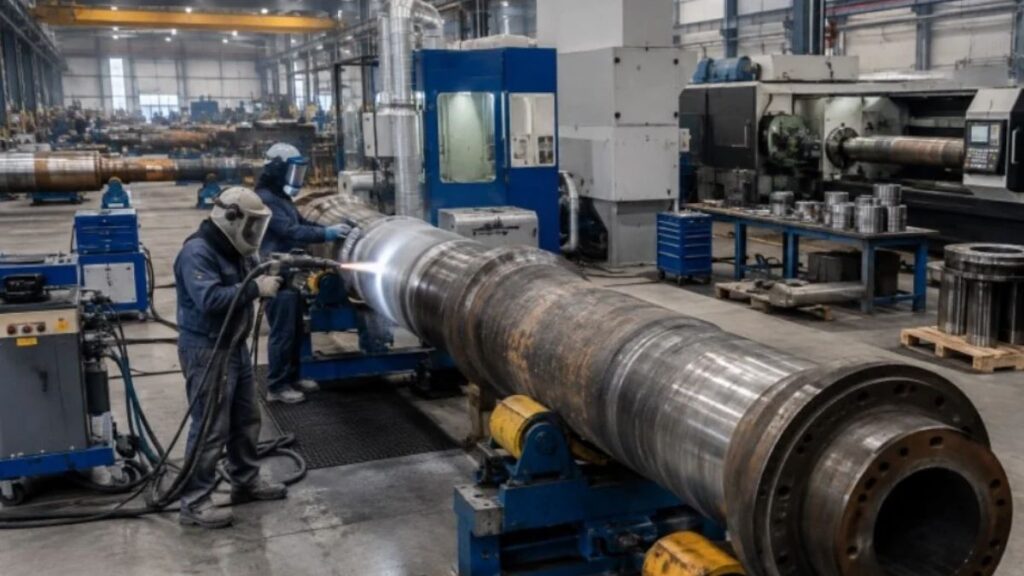
SURFALLOY’s twin-wire arc spray process melts two wires simultaneously and uses compressed air to propel atomized particles toward a prepared substrate. Grit blasting creates a textured surface that helps the deposited material mechanically interlock with the parent material. This preparation step is essential to producing a durable coating system.
Arc spray is used for dimensional restoration, wear surfaces, electrical conductivity, and friction-related applications. SURFALLOY lists applications that include shafts, bearings, pump seals, mixing blades, printing rolls, wear plates, and tool and die repairs. Its arc spray process can be applied to outside diameters, flat surfaces, and inside diameters up to 6 inches.
The company lists stainless steel, nickel chrome, carbon steel, cobalt nickel chrome, aluminum bronze, titanium, Kirksite, and Babbitt among common arc spray materials. It also identifies high deposition rates, focused spray patterns, dense coatings, and low heat input as process benefits. Thin components still require careful evaluation because preparation and spraying can create distortion risks in some geometries.
When Is Repair Preferable to Replacement?
Repair may be appropriate when a component has localized surface damage but remains structurally serviceable. For example, a shaft or bearing surface that has lost dimension may be restored and machined to the required finish when the substrate, geometry, and operating conditions are suitable. This can help reduce replacement spending, lead-time pressure, and downtime associated with sourcing hard-to-replace parts.
Coating is not the answer to every failure. Severe cracking, distortion, fatigue damage, or extensive substrate deterioration may require machining, welding, redesign, or replacement. A technical review before work begins helps establish whether restoration is realistic.
Choosing Between Arc Spray, HVOF, Carbide Treatment, and Hard Face Welding
SURFALLOY offers several approaches because different surface problems call for different coating characteristics:
- Arc spray: Often considered for dimensional restoration, wear resistance, conductivity, friction surfaces, and repairs to shafts, bearings, seals, rolls, and tooling.
- HVOF coating: A high-velocity oxygen fuel process for dense, hard coatings used on components such as wear plates, fan blades, gate valves, rolls, shafts, and turbine-related parts.
- Tungsten carbide surface treatment: Intended to improve grip, surface hardness, and wear resistance on suitable iron-based materials and tool steels.
- Hard face welding: Used for demanding wear, impact, galling, heat, and corrosion conditions where a fusion-bonded overlay is needed.
Surface preparation, coating thickness, adhesion, porosity, material selection, and finishing requirements all influence the final result. The surface preparation used before thermal spraying matters because a clean, properly roughened substrate supports adhesion of the deposited material.
HVOF and Tungsten Carbide Treatment for High-Wear Applications
HVOF uses combustion of fuel and oxygen to accelerate powder particles to high velocities. SURFALLOY lists tungsten carbide nickel, tungsten carbide cobalt, and chrome carbide among its common HVOF alloy systems. The company describes HVOF coatings as high-density, low-porosity, hard, and heat-resistant. Because it is a high-heat process, thin materials need careful handling to limit distortion.
SURFALLOY’s tungsten carbide surface treatment uses an electronically controlled pulsed-arc micro process to metallurgically bond tungsten carbide to a steel substrate. The company states that the process uses low heat input and can provide surface hardness up to 74 Rc. SURFALLOY also reports that customers have experienced tool-life improvements of two to six times normal life, although actual results vary by substrate, coating area, loading, maintenance, and service conditions.
How Hard Face Welding Addresses Severe Surface Damage
Hard face welding uses a high-energy electric arc and powdered metal to create a fusion-bonded overlay on the base material. SURFALLOY offers plasma transferred arc and powder arc welding for applications such as forging tools, dies, glass molds, valves, mining equipment, fan blades, scraper blades, knives, and mixing blades.
SURFALLOY states that its hard-face deposits can range from 0.060 to 0.500 inches and may achieve dilution below 10 percent in the listed single-pass applications. Available alloy categories include iron-based, nickel-based, cobalt-based, and tungsten carbide materials. This process can be a strong candidate where impact, galling, corrosion, or heavy wear make a thin surface treatment insufficient.
What to Include in a SURFALLOY Service Request
SURFALLOY lists normal service at two to three days, with one-day and same-day options available for additional charges. Actual turnaround depends on part condition, preparation, masking, machining, coating selection, quantity, and inspection requirements.
- Part name, application, and photos or drawings.
- Dimensions, coating area, and required final size.
- Base material and heat-treatment condition, if known.
- Failure symptoms, including abrasion, corrosion, impact, galling, or dimensional wear.
- Operating temperature, load, chemicals, speed, pressure, and contact conditions.
- Required delivery date and production priorities.
Extend Component Life With the Right Surface Strategy
SURFALLOY gives manufacturers a range of options for restoring dimensions, improving grip, resisting wear, and protecting industrial components from demanding service conditions. A complete part evaluation is the most reliable starting point for choosing among arc spray, HVOF, tungsten carbide treatment, and hard-face welding.