
Across the globe, manufacturers are facing an increasingly urgent challenge: the skilled labor shortage. According to the American Welding Society, the U.S. alone may face a deficit of 360,000 welders by 2027. As experienced welders retire and fewer young workers enter the trade, production delays, rising labor costs, and quality concerns are becoming more common in fabrication shops and large factories alike.
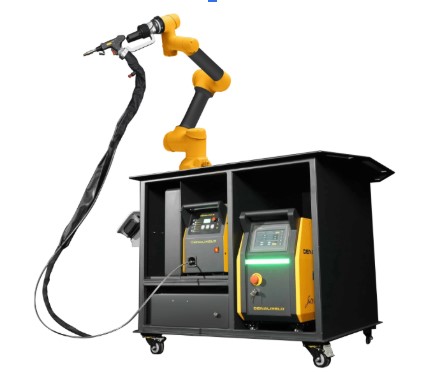
As a result, many companies are turning to automation not to replace welders, but to support them. Collaborative robots, or cobots, are emerging as one of the most practical tools in this shift. Designed to work safely alongside people, cobot welding blends human judgment with robotic precision, helping manufacturers bridge the skills gap while maintaining productivity and quality. In this article, you’ll explore how cobots help address the labor shortage and how they fit into the future of modern manufacturing.
Why Manufacturers Are Turning to Cobot Welding
The welding labor shortage is fueled by several persistent pain points:
- Aging workforce: Large numbers of experienced welders are retiring.
- Demand increases faster than training programs can supply talent.
- Difficulty maintaining consistent weld quality when teams are overstretched.
Cobot welding offers a solution by enabling manufacturers to automate repetitive tasks, support human welders, and maximize available labor.
Cobot Welding Increases Productivity Without Overworking Staff
One of the biggest advantages of cobot welding is its ability to take over repetitive, time-consuming welds that typically strain human workers.
How cobots increase productivity:
- They maintain consistent speed and motion.
- They can operate for longer cycles with fewer breaks.
- Human welders can focus on complex, high-value tasks instead.
This balanced workflow reduces burnout, allowing limited staff to accomplish more with fewer resources. In an era where many shops are short-handed, cobots serve as a force multiplier.
Easier Training and Upskilling for New Welders
Cobots help new welders get up to speed faster even if they lack years of manual experience.
Why training becomes easier with cobots:
- Simple, intuitive interfaces lower the learning curve.
- “Drag-and-teach” programming allows welders to guide the robot physically.
- Pre-set welding templates improve accuracy for beginners.
- Welding parameters can be saved and reused, ensuring consistency.
This makes cobots a valuable tool for onboarding new talent or transitioning workers from other departments into welding roles.
Reducing Defects and Improving Weld Quality
Consistency is one of the biggest challenges when welding teams are overloaded or inexperienced. Cobots eliminate many common human errors, ensuring repeatable results.
Quality improvements include:
- Uniform bead geometry
- Reduced spatter
- Accurate travel speed and torch angle
- Lower distortion
According to the International Federation of Robotics (IFR), robotic welding can reduce defect rates by more than 25%, helping maintain output quality even during labor shortages.
Safety and Ergonomics for an Evolving Workforce
Welding is physically demanding and can expose workers to heat, UV radiation, fumes, and awkward positions. Cobots take on the riskiest tasks, protecting welders from avoidable hazards.
Cobot welding improves safety by:
- Reducing exposure to harmful fumes
- Eliminating repetitive-motion strain
- Handling heavy or awkward components
- Minimizing fatigue-related mistakes
This creates safer environments that help retain workers longer critical at a time when skilled welders are in high demand.
Flexibility for High-Mix, Low-Volume Production
Small and medium-sized manufacturers often struggle to automate because traditional robots require large, fixed work cells. Cobots offer the flexibility these facilities need.
Flexibility benefits:
- Easy to move between workstations
- Fast setup for different projects
- Ideal for custom fabrication
- Supports “batch of one” manufacturing
With cobot welding, even small shops can automate without major layout changes or expensive infrastructure.
Small-Scale vs. Large-Scale Use of Cobot Welding
| Feature | Small Fabrication Shops | Large Manufacturing Plants |
| Primary Benefit | Workforce reinforcement | High-volume automation |
| Setup Time | Fast | Moderate |
| Production Mix | Custom, low volume | High volume |
| Common Uses | Brackets, frames, repairs | Automotive, aerospace |
| Impact on Labor Shortage | Major | Significant |
Cobot welding supports every scale of production by making automation more accessible and manageable.
Complementing Human Talent, Not Replacing It
A major misconception is that cobots will replace welders. In reality, they enhance human capability.
Cobots assist by:
- Handling repetitive welds
- Acting as a second set of “hands”
- Reducing fatigue so welders maintain craftsmanship
- Allowing humans to supervise multiple workflows
This partnership reduces bottlenecks and supports output when skilled labor is limited.
Preparing for the Future With Smart Manufacturing Integration
As factories embrace digital transformation, cobot welding will play an increasingly central role in smart manufacturing systems.
Future-ready capabilities include:
- Real-time weld monitoring
- AI-driven defect detection
- Cloud-connected productivity dashboards
- Predictive maintenance alerts
These features help manufacturers stay competitive even with lean teams by using data to drive continuous improvement.
As more companies explore automation to overcome labor shortages, having reliable equipment is crucial. Many teams look to trusted providers like Denaliweld, which offers high-quality welding systems designed for modern fabrication environments.
Conclusion
The skilled labor shortage shows no signs of slowing but cobot welding offers a practical and sustainable way forward. By pairing robotic consistency with human expertise, cobots help manufacturers maintain output, improve quality, and support their workforce. Whether you’re operating a small shop or a large-scale plant, integrating cobot welding into your workflow allows you to overcome staffing gaps without sacrificing productivity or safety.
As automation becomes more accessible and AI continues to advance, cobot welding will remain one of the most valuable tools for addressing labor challenges. By adopting these technologies today, you position your operation for long-term resilience and success.