
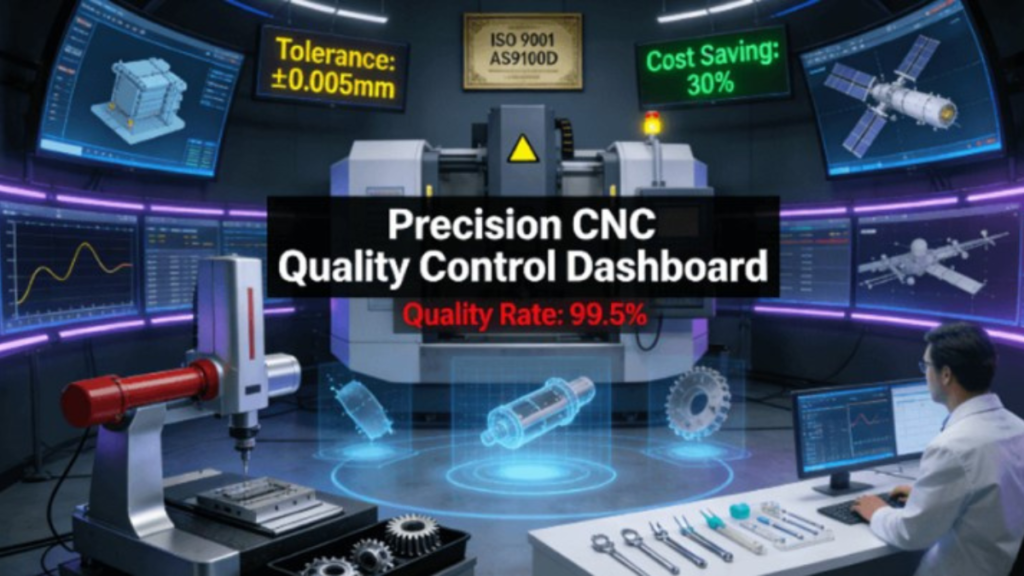
In modern manufacturing, business organizations face very harsh challenges such as uncontrolled tolerance, delivery issues, and cost margin violation, especially when producing high-precision components. The traditional manufacturing approach may involve scrap rates of up to 30%, which highly impacts the timeline and bottom-line profits. However, the problem originates from the absence of systematic process control, quality system implementation, and technical capability on the part of the suppliers, resulting in the majority of businesses being left in a helpless loop of trial and error.
This article shall discuss the technical processes, applications at the industry level, and cost-saving mechanisms for services related to high-precision CNC machining, providing readers with ways and means to effectively mitigate risks at the roots.
What Are the Critical Challenges in Achieving Tight Tolerances in CNC Machining?
To achieve a tolerance on the micron order is a complex task due to mainly thermal deformation, tool wear, and material stress relief. This includes the variation in the workpiece size due to the heat produced from the high-speed machine spindle that can be well above 0.01mm, tool wear during machining of high-strength alloys.
1. The Impact of Thermal Dynamics and Tool Wear
In high-speed machining operations, the generated heat energy due to the spindle motion as well as the cutting force will result in the thermal expansion of the machine tool and the material. This can potentially produce deviations under conditions not properly controlled by temperatures. Wear on the tool is also induced due to machining, resulting in increased force levels during machining and disrupting the quality of the surface integrity. Tool wear can also be identified through monitoring of the sensor for changes.
2. Material Stress and Geometric Complexity
The internal stress of the material may be relieved during machining, in which the piece may deform after it has been released from the fixturing. Such a situation is difficult in the case of pieces with thin-walled geometry and/or asymmetric geometry. It may require a strong annealing operation to relieve stress before final machining.
3. Adherence to International Standards like ASME Y14.5
It is necessary to ensure tight tolerance machining within a framework established through recognized standards. The standard ASME Y14.5 offers a set of specifications for GD&T in such a manner that protects the design intent. Therefore, indeed, respecting recognized standards is the foundation for any precise CNC machining service trying to ensure consistency in CNC machining.
How Can Advanced CNC Technology Drive Efficiency in Multi-Industry Applications?
Enhanced CNC technology increases the level of efficiency in the manufacturing sector. Mass customization has this technology at its backbone. This high-level technology is a must in this digital era.
1. Aerospace: Complex Part Consolidation
In the aerospace industry, machining centers can perform machining on all complex curved surfaces needed for a titanium engine bracket in a single fixture using a 5-axis machining center. The machining center can complete a job that would take several processes, reducing the time taken by a considerable amount, by more than 60% in fact, without any errors due to re-fixuring, for producing light weight, high strength parts.
2. Medical: High Precision for Demanding Applications
In light of medical appliances like orthopedic implants, the CNC turning and milling compound technology is an aid in forming micro-hole structures with higher accuracy in accordance with the requirements of ISO 13485 for medical appliances. Moreover, precise machining of biocompatible materials like titanium and PEEK leads to CNC machining services being an essential for patient and product safety.
3. Automotive and Robotics: Speed and Precision
In the automotive sector as well as robotics, speed and accurate results are of utmost concern. High speed machining techniques along with pallet systems implemented at the OEM parts CNC manufacturer allow producing a large number of parts such as molds and actuators with shortest possible lead time while still meeting the needed accuracies required for proper assembly functions.
What Role Do Certified Quality Systems Play in Ensuring Manufacturing Reliability?
“The essential quality of reliable manufacturing is based on qualified quality systems: quality not simply documented but actively prevented.” They provide a structure of traceability.
The Framework of ISO 9001: The ISO 9001 quality management system specifies requirements for controls throughout all stages from design input to final inspection. This makes all stages traceable and auditable, encouraging a spirit of continuous improvement with a marked reduction in rework instances in mass production.
Sector-Specific Standards: AS9100: In industries that involve highly regulated processes, AS9100D also requires more stringent standards. Some areas where this occurs include First Article Inspection, Supply Chain Risk Management, and Defects Analysis. For CNC machining companies to certify to this requirement, they show capability to deliver highly dependable parts.
Proactive Defect Prevention: The true benefit these systems offer is their defect-prevention proactive approach, not just a means for scanning once a product is manufactured. With the ability to control the process, factors that can cause a defect can be eliminated. This is exactly where a quality partner diverges from a simple vendor to make quality a process from the onset.
How to Optimize Costs Without Compromising on CNC Machining Precision?
Cost optimization applies best and is most effective early in the design and planning stage. Strategic decisions can provide huge savings with no compromise on quality.
1. Design for Manufacturability (DFM) Analysis
A basic approach is early DFM analysis. It can reduce machining time by more than 30%, by simplifying part geometry through the avoidance of non-standard holes and sharp corners. Consulting with your supplier in the design phase to optimize the part for the CNC machining process is a crucial step toward cost-effective production.
2. Strategic Material and Process Selection
Material type significantly affects the cost. Where performance criteria permit, a switch from titanium to an easier-to-machine aluminum alloy can cut material and processing costs in half. Additionally, tighter tool paths and automated fixturing during batch production further reduce unit costs. A responsible first step in understanding these drivers involves how to get a transparent CNC machining quote and pricing breakdown.
3. Leveraging Advanced Machining Strategies
Technologies such as high-efficiency machining enable deeper cuts and faster feed rates when possible, thereby reducing cycle times. In other words, with any custom CNC machining project, there is no more direct route to cost savings while maintaining precision than leveraging a supplier’s expertise in selection of the most efficient machining strategy for a given material and geometry.
What Are the Emerging Trends in Digital Manufacturing for CNC Processes?
“Digital manufacturing is transforming CNC machining with the incorporation of both IoT and AI, with an aim to move towards data-driven optimization in the future.”
1. IoT and Predictive Analytics: Sensors on these machines record processing information including spindle load, temperature, and vibration. All these processing information are then analyzed through cloud platforms to enable predictive maintenance services such as predicting the life of the cutting tools to maximize machine utilization.
2. AI-Driven Process Optimization: It is now possible to dynamically optimize the milling parameters (speed, feed rate, and depth of cut) through the use of AI. This results in optimal surface finish (with Ra < 0.4 μm) and improves the feed rate by 20%, which is a balance between quality and productivity.
3. Digital Twins for Virtual Validation: The technology of digital twins enables a copy to be made of the entire machining process. A team of engineers can use this process to check the paths of tools offline, thereby ensuring validation, all within a short time-to-market, often described using precision CNC machining services.
How to Select a CNC Machining Supplier for High-Stakes Projects?
When looking to procure a supplier for high-risk projects, a holistic evaluation process is required that goes past cost alone. Ideally, your chosen supplier should be a continuation of your own engineering staff.
1. Technical Capability and Capacity
Evaluate the technical resources available from the supplier: number of multi-axis CNC machining abilities, ability to achieve tolerance specifications down to ±0.005 mm, as well as available advanced metrology instruments such as CMM. This is to ensure they can provide a hardware support for their technical specifications.
2. Quality Certifications & Cultural Commitments
Check for the necessary certification such as ISO 9001 and AS9100D. However, the critical part is to assess the quality culture of the supplier. Are the suppliers displaying a proactive approach to problem-solving, or is their integration level very low compared to the quality system implemented by the suppliers?
3. Engineering Support and Collaboration
A good CNC OEM part supplier should offer strong engineering support with proactive DFM analysis. Their ability to respond to inquiries, willingness to work together as a partner, are critical soft skills to have for an amiable partnership relationship for successful projects.
Conclusion
CNC machining services, based on systematic tolerance control, cross-industry technology applications, quality system certification, and intelligent cost optimization, have also become an important technology solution for the manufacturing sector. When combined with digital manufacturing trends, it is bound to promote the upgrade of the manufacturing sector, allowing companies to steer clear of costly mistakes in order to enjoy successful development.
FAQs
Q1: What is considered a typical lead time for a precision CNC machining job?
A: The lead time depends on complexity; however, for standard parts, there may be 3-5 days delivery. The suppliers with efficient processes and ISO 9001 certification tend to provide expedited services without costing much on the quality of projects.
Q2: What are differences/similarities between CNC machining and 3D printing for functional prototypes?
A: CNC machining offers much higher accuracy (to 0.025 mm) and material strength for functional parts. 3D printing qualifies as the process of rapidly prototyping complex shapes but tends to have weaker mechanical properties in terms of strength and durability.
Q3: What materials can be used for high-pressure applications for CNC machining?
A: Stainless steel 316 and titanium Grade 5 are corrosion and stress-resistant metals. In plastics, PEEK can resist high temperatures and mechanical stresses. It is important to note that the choice of materials should depend on the working conditions and stresses.
Q4: Is CNC machining capable of maintaining tolerances within ±0.01 mm for mass production?
A: Yes. Tolerance values of ±0.005 mm are possible with multi-axis machines and in-process monitoring systems. This quality is maintained by Statistical Process Control (SPC) methods, ensuring quality within large batches.
Q5: What is the effect of certifications such as AS9100D on supply chain management?
A: Industry certifications like AS9100D include stringent traceability and risk controls. This is extremely important in the aerospace sector and other high-risk fields. AS9100D is considered essential while selecting a partner for high-risk components since it denotes maximum reliability and quality.