
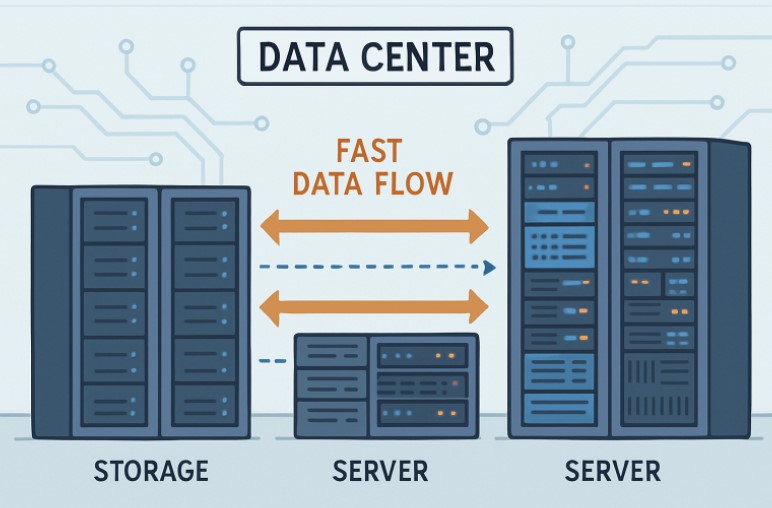
The exponential growth of data in today’s business landscape, driven by fields such as artificial intelligence, real-time analytics, and e-commerce, has made robust and scalable storage solutions a fundamental requirement. Organizations are expected to store, secure, and access massive amounts of information with minimal latency and maximum performance—something traditional systems often struggle to deliver. As a response, modern SAN storage for businesses has evolved into a key enabler of digital transformation, meeting these demands with advanced features and flexible deployment models.
Companies utilizing advanced SAN infrastructure can efficiently manage both structured and unstructured data, essential for large and mid-sized organizations in competitive markets. Modern SAN systems ensure reliability, speed, and compatibility with emerging technologies, thereby enhancing operational efficiency and extending the longevity of the infrastructure. SAN storage not only stores data but also enhances value through advanced analytics, cloud integration, and robust data protection. The evolution of SAN architectures is crucial for decision-makers seeking to invest in storage solutions that foster digital growth and innovation.
Evolution of SAN Storage
Storage Area Networks were initially deployed to consolidate and manage enterprise storage via interconnected disk arrays and Fibre Channel networks. Historically, these early SANs centered on spinning hard disk drives, which, although reliable, often suffered from latency, scaling limitations, and cumbersome management. The introduction of solid-state drives (SSDs) and high-speed Ethernet dramatically transformed this landscape, making SAN architecture far more efficient, scalable, and cost-effective.
Modern SAN solutions now provide agility and performance that meet the demands of mission-critical applications. Enhanced protocol support, automated management tools, and sophisticated quality-of-service policies contribute to a smoother and more predictable storage environment. Legacy systems, which were rigid and maintenance-heavy, are being replaced by modular, software-defined SANs that offer enterprises greater flexibility and reliability as their data storage needs grow.
NVMe over Fabrics: Enhancing Performance
NVMe over Fabrics (NVMe-oF) marks a significant leap in SAN capabilities. Traditional storage protocols, such as SCSI, while reliable, were designed for spinning disks and struggle to leverage the ultra-low latency and parallelism of modern flash storage. NVMe-oF extends the already-fast NVMe protocol across data center fabrics—such as Ethernet, Fibre Channel, and InfiniBand—unlocking unprecedented throughput and minimizing latency. This results in rapid access to data, which is crucial for high-transaction environments, virtual desktop infrastructures, and use cases that demand real-time insights.
According to TechTarget, NVMe-oF is quickly becoming a mainstay in enterprise infrastructure due to its ability to efficiently support the explosion of data generated by IoT and AI workloads.
All-Flash Arrays: The Rise of Speed and Reliability
The migration from traditional hard disk drives to all-flash arrays (AFAs) is another significant trend in the evolution of SANs. AFAs, built exclusively with SSDs, deliver lightning-fast performance, enabling higher IOPs and drastically reducing latency. Their efficiency is further enhanced by modern data reduction technologies, such as deduplication and compression, resulting in a lower total cost of ownership. AFAs are also more energy-efficient and compact, reducing data center footprints and operational costs.
The enhanced capabilities of AFAs, along with their built-in features such as encryption and automated tiering, make them ideal for enterprises seeking to future-proof their storage environments. These advantages are especially pronounced in sectors where performance and availability are non-negotiable, like finance, healthcare, and e-commerce.
Convergence of SAN and NAS
Hybrid storage deployments are on the rise, offering both SAN (block-level) and NAS (file-level) functionalities in unified appliances. This convergence enables businesses to consolidate resources, simplify management, and adapt to a broader range of application requirements. Hybrid SAN/NAS systems enhance flexibility by providing a single management interface, allowing workloads optimized for both block and file access to coexist seamlessly.
This approach not only reduces infrastructure complexity but also helps organizations maximize their return on investment while supporting digital transformation initiatives.
AI Integration in SAN Storage
The infusion of artificial intelligence and machine learning into SAN storage systems has redefined what’s possible in data management and optimization. AI-driven analytics can forecast storage utilization trends, automate data placement, and predict potential hardware failures—allowing for proactive maintenance and minimizing unplanned downtime. Additionally, machine learning algorithms help optimize data flow and workload distribution, further boosting system efficiency and application performance.
As data environments become increasingly complex, the ability to harness AI for predictive diagnostics and automated operations will become an increasingly indispensable advantage for enterprises seeking to stay ahead of the curve.
Security Considerations in Modern SAN Solutions
Data breaches and cyberattacks are a constant threat, making security one of the most critical aspects of modern storage. Today’s SAN solutions are architected with built-in protection features, including data-at-rest encryption, secure multi-tenancy, role-based access controls, and immutable snapshots to defend against ransomware and insider threats. Adhering to security best practices and compliance standards such as GDPR is now an expected baseline in enterprise storage deployments.
Enterprises must continuously assess and update their SAN security policies to keep pace with the evolving cyber landscape, ensuring that sensitive business and customer data remains protected.
Future Trends in SAN Storage
The coming years will see further innovations that reshape SAN storage. A notable development is the adoption of disaggregated or composable infrastructure, where compute, storage, and network resources are independently scalable and can be managed separately. This approach enables businesses to align storage resources precisely with their workload requirements, thereby reducing waste and enhancing efficiency.
Additionally, computational storage devices (CSDs), which embed processing power directly within storage arrays, are poised to accelerate analytics and machine learning workloads by reducing data movement and offloading intensive computations from central processors. These advancements will enable organizations to derive actionable insights from their data more quickly than ever before.
Conclusion
The evolution of SAN storage solutions has been instrumental in helping businesses manage, protect, and derive value from rapidly growing volumes of data. By embracing technologies such as NVMe-oF, all-flash arrays, AI-powered management, and hybrid SAN/NAS architectures, organizations can stay ahead of future growth and innovation. Staying ahead requires a proactive approach: investing in the proper infrastructure today to support tomorrow’s breakthroughs is vital for maintaining a sustainable competitive edge.